Tuesday, 18 March 2014

Florida Part 2/3: The Keys

After a great day in the Everglades we decided to head down from Florida City to Marathon, a large island in the middle of the Florida Keys.  Along the way we stopped at several spots in Key Largo including one of our favourites, John Pennekamp State Park.

Kayaking in the mangroves in John Pennekamp!
Mangroves! We saw a sting ray right near this spot, but it was too quick to get a picture

Palm Warbler was the most common warbler in the keys
John Pennekamp had some really neat walking trails
The grove trail

The grove had lime trees!
Unidentified lizard.
Crappy shot of a breeding Lesser Black-backed Gull
Marathon keys sunset
We hiked the short trails at Crane point on Marathon Key, which is a beautiful nature preserve that encompasses some of the largest intact forests in the keys.
Crane Point Marathon key
Hammock Skipper
Thatched Palm?, common in forests within the keys- Caitlyn's favourite plant of the trip!
The Crane Point
After Marathon Key, we visited the nearby Bahia Honda Key State Park, renowned mostly for its beautiful white sand beaches.

Rated the best beach in America in 1993.
Bahia Honda Beach
One of our favourite, less crowded parks was Curry Hammock State Park.  This spot boasted awesome beaches and much more wildlife than Bahia Honda.

Curry Hammock State Park
Semi-palmated Plover, should soon be on his way up north to breed

Sanderlings and Black Skimmer
Beautiful sand and water of Curry Hammock

Jellyfish sack
Curry Hammock Trail
Whiptail species.  I find these guys hard to tell apart. 
One day we visited the historic Key West, renowned for its shops, night life and sight seeing.  The town itself is beautiful, with massive trees and vines encircling large, beautiful, southern style homes.

Key West


Ernest Hemingway's house.  He doesn't live there anymore

St. Mary's Star of the Sea Basilica


Key West Marina

My apologies for all those pictures of buildings and towns.  We will now get back to the important nature stuff.

Black Skimmers having a good time at the Key West docks

Two of three White-crowned Pigeons we saw in the keys.  Very rare outside of southern Florida

And of course a Brown Pelican!
Part 3 of this blog will show photos from what was arguably the most exciting part of the trip, a 70 mile boat journey to Dry Tortugas National Park! I should have that up in the next couple days.  Stay tuned!

Saturday, 15 March 2014

Florida Part 1/3: The Everglades

Over March break, Caitlyn and I flew down to Florida to see the everglades and the Florida Keys.  The everglades far exceeded my expectations and I would put it on the list of one of the top areas to visit for wildlife viewing anywhere.  The sheer abundance and accessibility of wildlife in Everglades National Park is jaw dropping.  I was like a kid in a candy store when just past the park entrance I came upon a puddle containing Great Egret, Great Blue Heron, Snowy Egret, Little Blue Heron, Anhinga, Black Vulture and Glossy Ibis! Caitlyn didn't like the biting mosquitoes which seemed to heavily favour her over me, they seemed pretty mild to me.  Nothing like the boreal forest in June!

Our first stop after the visitor centre was the Anhinga Trail.  This is a short boardwalk that takes you on a walk through the swamp and gives ample viewing of birds, gators and other wildlife.
Caitlyn poses beside the Anhinga trail.
Wildlife was very easy to photograph and not at all bothered by people walking several feet away.
Anhinga drying out.
Baby Anhinga's being fed.  The long neck is what gives them the nickname 'snake-bird'
Boardwalk at Anhinga Trail
Black Vulture, Snowy Egret, Great Blue Heron
Glossy Ibis
Great Egret
Little Blue Heron
Alligator on the Anhinga Trail
Caitlyn's favourite bird of the trip, White Ibis
The wildlife on this trail was very comfortable with people!  This guy was basking just a few metres away!
Green Heron waiting for a meal.
Wood Stork
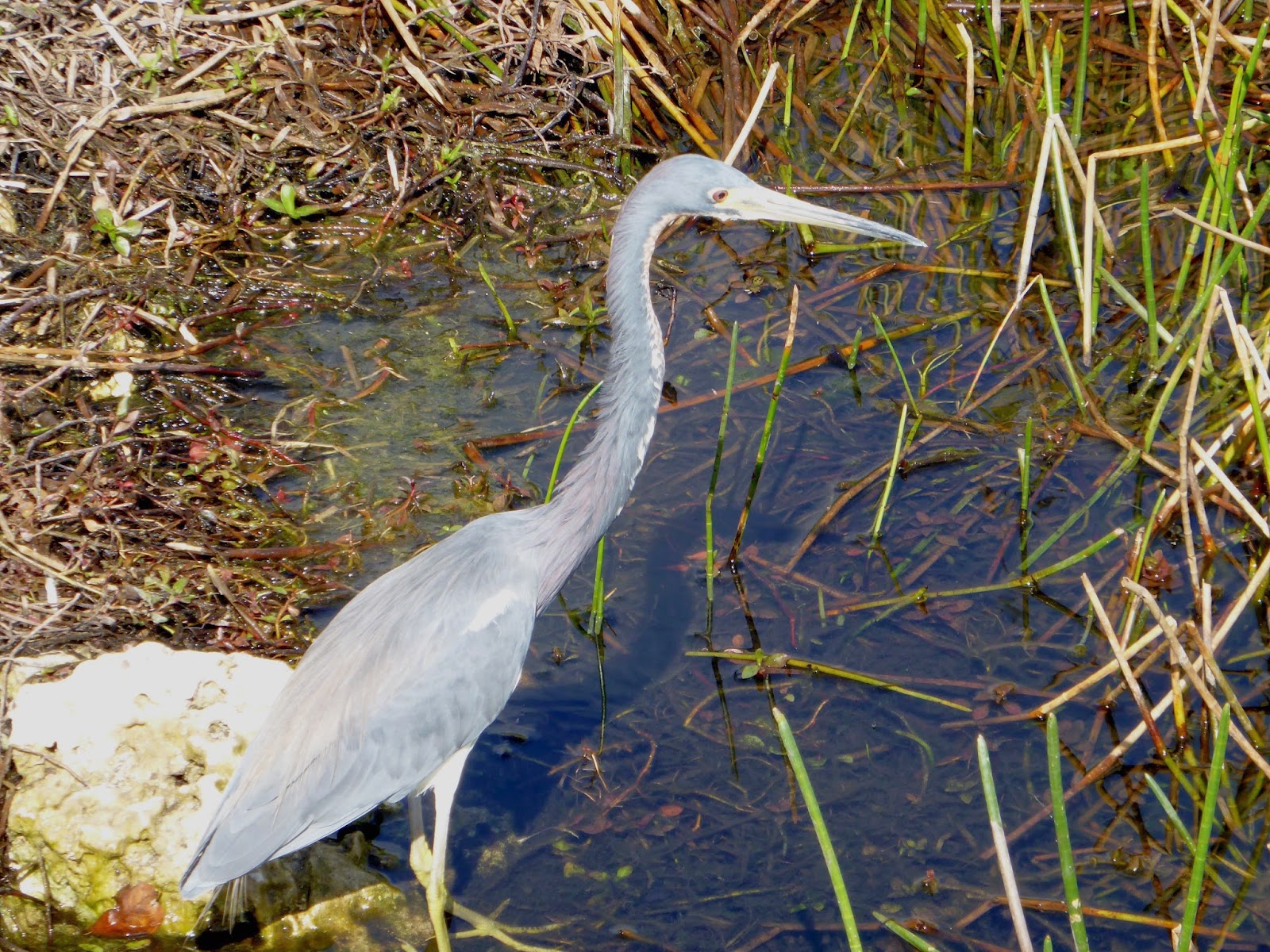
Tri-coloured Heron
Purple Gallinule! He didn't like being seen and quickly scampered into the swamp with his prize.
Red-bellied Woodpeckers were the most common woodpecker in the Everglades.
Florida Red-bellied Turtles
Black Vulture cleaning beak on the railing
View from the Anhinga Trail boardwalk
After the Anhinga Trail, we walked several others along the main highway through the southern Everglades.  What surprised us was the sheer diversity of habitats in the area.  Within a single trail you could easily move from open swampland to impenetrable mangroves to dense upland jungle.  

We also took a walk through the Pinelands Trail.

Pinelands Trail
The only White-eyed Vireo we saw on the trip was on the Pinelands Trail
Other cool trails we hiked included the Pahayokee Trail, Mahogany Hammock Trail and the West Lake Trail.  Each of these produced more amazing wildlife and scenery.

Barred Owl chick hides amongst the dense vegetation of this massive tree.
Bald Cypress trees dot the landscape.  These trees are not dead but in a dormant state to ride out the "winter"
One of the things that most impressed me about the Everglades was the sheer expanse of this wilderness. 
One of our favourite trails was the West Lake trail.  This trail begins in dense mangroves and ends at West Lake.  I encountered a couple good warbler flocks on this trail and saw American redstart, northern waterthrush, prairie, yellow-rumped, black-throated blue, palm and black-and-white warblers. 

West Lake mangroves
Exiting the mangroves and entering West Lake
After these trails we headed down to Flamingo, a location where the Everglade swamps meet the ocean.  On the drive down we observed several swallow-tailed kites, but unfortunately didn't get any photos.
Nope its not a flamingo, its a Roseate Spoonbill.  Too bad he wouldn't pose for a picture.
Coastal prairie trail near Flamingo
Haven't seen green like this since last summer!
I love the spanish moss hanging from the trees!
Great-crested Flycatchers were common on many of the upland trails near Flamingo.
Willet near Flamingo.
The elusive American Crocodile.  These guys were hanging out in the Flamingo marina and one of them was huge! Don't fall in!
Near Flamingo we stopped at Eco Pond, a muddy  little body of water packed with ducks and shorebirds.
Eco Pond near Flamingo
Black-necked Stilt
Black-necked Stilt!
American Avocet
Other random wildlife shots from the everglades are below.  So much stuff flying, swimming and running around!
I think this is a Southeastern Five-lined Skink.  Correct me if I'm wrong.
Gulf Fritillary were common in open areas.
Brown Anole
After a long, wonderful day in the Everglades we headed back to the hotel in Florida City and had a few other birds of note.
Loggerhead Shrike! An Endangered species in Ontario.
Common Myna on the Walmart sign in Florida City!  A close relative of the starling and also an introduced species, but far less invasive.
Here are a couple cool videos from the Everglades that I posted on youtube. Check em out!